The Legend of King Arthur
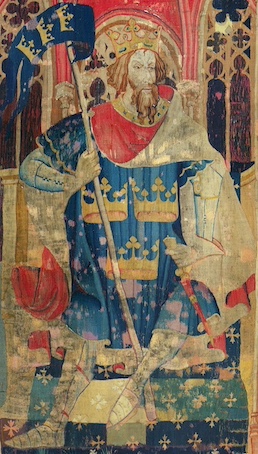
Tapestry showing Arthur as one of the Nine Worthies,
wearing a coat of arms often attributed to him (c. 1385)
King Arthur
During the years 500 - 550AD Britons appear to have held back the Saxon advance. However, in the following years they were forced back into Cornwall and Wales. The territory held by the Saxons eventually became known as England and the people in Wales were called 'Welsh' from the Saxon word 'weala' meaning 'foreigners'. The British people living in Wales did not fully accept the title 'Welsh' until the 12th century.
The Saxon conquerors were unlikely to be interested in the exploits of a 'foreign' leader who was successful in holding them at bay and this reason may explain why Arthur is not mentioned in early English chronicles while his name occurs in Welsh ones.
The first reliable reference to Arthur is in the 'Historia Brittonum' written by the Welsh monk Nennius around the year 830AD. He refers to Arthur as a warrior - not a king - and lists twelve battles fought by Arthur including Mount Badon and the City Of The Legion.
It was the work of Geoffrey of Monmouth, another Welsh cleric, which set down the foundations of the Arthurian legends in his work, 'Historia Regum Britaniae' written in the year 1133AD. He claimed to have based the work on an ancient Celtic document in his possession.
During the years 500 - 550AD Britons appear to have held back the Saxon advance. However, in the following years they were forced back into Cornwall and Wales. The territory held by the Saxons eventually became known as England and the people in Wales were called 'Welsh' from the Saxon word 'weala' meaning 'foreigners'. The British people living in Wales did not fully accept the title 'Welsh' until the 12th century.
The Saxon conquerors were unlikely to be interested in the exploits of a 'foreign' leader who was successful in holding them at bay and this reason may explain why Arthur is not mentioned in early English chronicles while his name occurs in Welsh ones.
The first reliable reference to Arthur is in the 'Historia Brittonum' written by the Welsh monk Nennius around the year 830AD. He refers to Arthur as a warrior - not a king - and lists twelve battles fought by Arthur including Mount Badon and the City Of The Legion.
It was the work of Geoffrey of Monmouth, another Welsh cleric, which set down the foundations of the Arthurian legends in his work, 'Historia Regum Britaniae' written in the year 1133AD. He claimed to have based the work on an ancient Celtic document in his possession.
Morgan the Generous
The Welsh King Morgan ab Athrwys (also known as Morgan Mwynfawr - ‘Morgan the Generous’) is known to have decreed the use of juries in 725 AD. His chief citadel was located in or near Cardiff, where as the engraving from Cardiff on display in the Grand Jury Museum demonstrates, the legend of King Arthur maintains a modest though still present cultural influence.
Morgan the Generous was a king of Gwent and Glywysing (i.e., Morgannwg), roughly equivalent to the present county of Glamorgan. He is said to have declared, "For as Christ and his 12 apostles were finally to judge the world, so human tribunals should be composed of the king and 12 wise men."
Morgan was the son of Athrwys ap Meurig, thought by some to be the example around which the legend of King Arthur originated - hence, possibly, the twelve knights of the round table, the apostles and the jury.
The Welsh King Morgan ab Athrwys (also known as Morgan Mwynfawr - ‘Morgan the Generous’) is known to have decreed the use of juries in 725 AD. His chief citadel was located in or near Cardiff, where as the engraving from Cardiff on display in the Grand Jury Museum demonstrates, the legend of King Arthur maintains a modest though still present cultural influence.
Morgan the Generous was a king of Gwent and Glywysing (i.e., Morgannwg), roughly equivalent to the present county of Glamorgan. He is said to have declared, "For as Christ and his 12 apostles were finally to judge the world, so human tribunals should be composed of the king and 12 wise men."
Morgan was the son of Athrwys ap Meurig, thought by some to be the example around which the legend of King Arthur originated - hence, possibly, the twelve knights of the round table, the apostles and the jury.
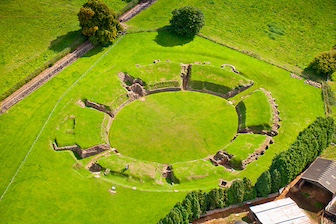
Caerleon Roman Amphitheatre
© Crown copyright (2013) Visit Wales
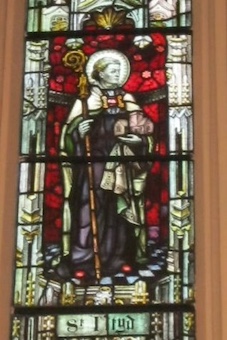
St. Illtyd in Holy Trinity Church
Abergavenny
© Gwenddwr
Romano-British Christian rule was well established in South East Wales defended primarily by a permanent legionary fortress at Caerleon with auxiliary fortresses including one at Cardiff. A dozen miles to the east of Caerleon, Caerwent was the only Roman walled city in Wales. Founded around AD 75 it was the largest Roman civilian settlement in Wales and served as a market town and capital for the Silures tribe.
It is correspondingly feasible that the legend of Arthurian resistance to Anglo-Saxon invasion and its pagan influences is based chiefly upon developments in Glamorgan under the protection of the most well defended citadels of Roman Christian civilisation in western Britain. The circular amphitheatre in Caerleon is thought to have served as the meeting venue for Arthur’s governing council.
It is correspondingly feasible that the legend of Arthurian resistance to Anglo-Saxon invasion and its pagan influences is based chiefly upon developments in Glamorgan under the protection of the most well defended citadels of Roman Christian civilisation in western Britain. The circular amphitheatre in Caerleon is thought to have served as the meeting venue for Arthur’s governing council.
These possibilities are supported by the fact that settlements in Glamorgan were more self sustaining than London itself, which was more dependent upon supplies shipped from within the Roman Empire still organised upon the Continent. Once these lines of supply were disrupted by Germanic invasions London citizens fell prey to the hegemony of Saxon tribes more quickly than Britons settled in South East Wales.
Moreover, although British resistance to the Germanic invasions occurred along most of the west of Britain from Cornwall to the Roman city of Carlisle, Glamorgan itself enjoyed closer logistical relations with the European continent.
Brittany gets its name from this relation, not least because this was the region to which many Roman legionaries withdrew from south western Britain itself as of 410AD.
Consistent with these considerations is the fact that after the Romans withdrew the chief centre of learning, education and Christian influence remained in Llantwit Major in the fertile Vale of Glamorgan, west of Cardiff. Here the largest monastic settlement in Wales regularly attracted over seven hundred Brethren from across many countries for study purposes.
Llantwit Major achieved international status as one of the finest centres of learning in Europe as a whole. It was led by the ‘venerable Abbott Illtyd’ later to be elevated to Sainthood. Illtyd had also lived in Brittany, and was claimed to have originally been in his youth a warrior known as Galahad, cousin to King Arthur.
Archeology confirms that a second wave of migration from Cornwall and Devon occurred in the sixth century, perhaps coinciding with the defeat of most Arthurian resistance about that time.